


























Bitcoin briefly touches $24,000 in isolated move on Binance’s USD1 pair
Bitcoin briefly touches $24,000 in isolated move on Binance’s USD1 pair. Such sudden price changes are often due to thin liquidity and can be exacerbated by fewer active traders during quieter hours.
|
Key points:
|
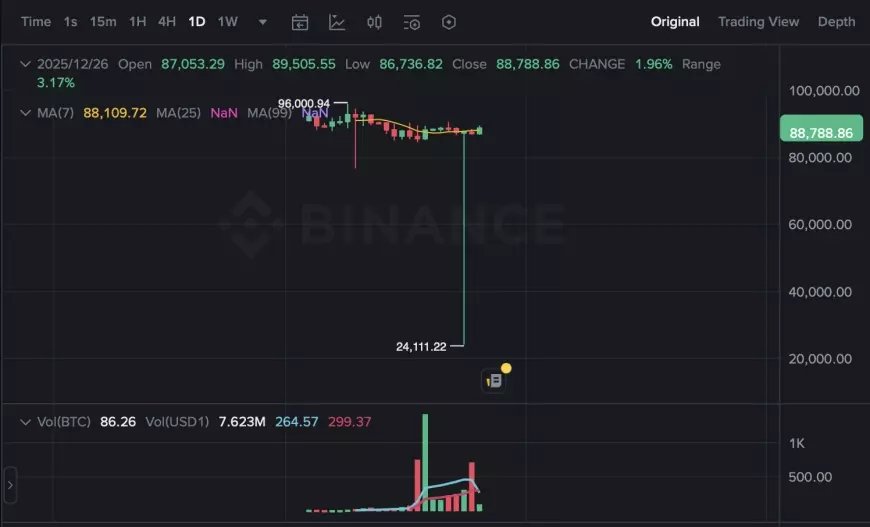
Bitcoin briefly printed $24,111 on Binance late Wednesday, appearing as a sharp wick on the BTC/USD1 trading pair. According to exchange data, the price snapped back above $87,000 within seconds.
The move was short-lived and did not reflect the broader market. Within moments, bitcoin was trading back near prevailing prices.
Why the Wick Appeared Only on BTC/USD1
Isolated to a Single Trading Pair
The sudden drop did not show up on other major bitcoin pairs. It appeared only on BTC/USD1, a pair linked to USD1, a stablecoin launched by Trump family-backed World Liberty Financial.
Shortly after, the pair normalized, suggesting the issue was isolated rather than market-wide.
Thin Liquidity and Shallow Order Books
These kinds of sharp wicks are usually tied to thin liquidity, or in some cases, a temporary display issue, rather than an actual crash.
New or lightly traded stablecoin pairs often have:
-
Fewer market makers
-
Wider spreads
-
Shallower order books
As a result, prices can move abruptly when even a single large order hits the market.
How Large Orders Can Trigger Extreme Prints
When One Trade Moves the Market
A single large market sell, a liquidation, or an automated trade routed through a low-liquidity pair can quickly sweep available bids. When that happens, the price can momentarily print far below the true market level.
The price typically rebounds once buy orders return and liquidity refills the book.
Other Technical Factors at Play
Temporary dislocations like this can also be caused by:
-
Sudden spread widening
-
Faulty price quotes from a market maker
-
Trading bots reacting to abnormal price prints
During quieter trading hours, these effects can be more pronounced, as fewer participants are active to absorb order flow and restore price parity.
How Traders Interpret These Events
While such wicks may look alarming on a chart, traders generally see them as microstructure events, not signals of bitcoin’s broader direction.
That said, the incident serves as a reminder of the risks involved when trading through thin or newly launched pairs, especially those still building liquidity.
Layer-1 Tokens Struggled Despite Structural Progress in 2025
Beyond this isolated market event, 2025 highlighted a broader trend across crypto markets. Layer-1 tokens largely underperformed, even as regulatory clarity improved and institutional involvement grew.
Structural Growth vs. Price Performance
A Year of Divergence
The year was marked by a clear split:
-
Network usage and total value locked (TVL) increased across many ecosystems
-
Yet most large-cap Layer-1 tokens ended the year with flat or negative returns
Institutional milestones were achieved, but price action failed to reflect that progress.
What This Report Examines
This report looks at the structural decoupling between network fundamentals and token prices. It analyzes 10 major blockchain ecosystems, focusing on:
-
Protocol revenue versus application revenue
-
Core ecosystem narratives
-
Mechanisms driving institutional adoption
-
Key trends to watch as the market moves toward 2026
The findings help frame why strong on-chain growth has not yet translated into sustained token performance.
Website: ONFA.US
| DISCLAIMER: The information on this website is provided as general market commentary and does not constitute investment advice. We encourage you to do your own research before investing. |
What's Your Reaction?